Residential Estates
Double the portfolio. Built to handle more.
How Residential Estates scaled from 130 to 260 units with Guestflow supporting its nationwide operation.
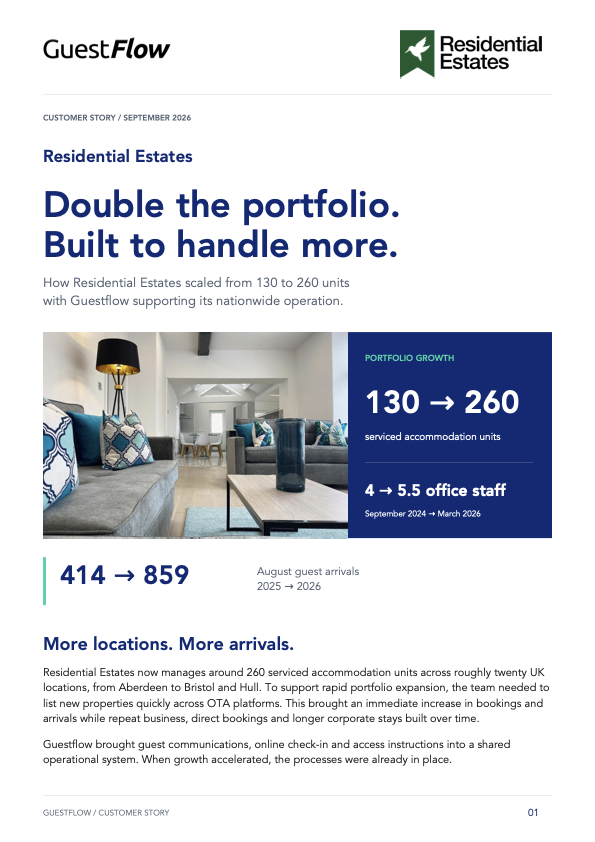
serviced accommodation units
4 → 5.5 office staff (Sep 2024 → Mar 2026)More locations. More arrivals.
Residential Estates now manages around 260 serviced accommodation units across roughly twenty UK locations, from Aberdeen to Bristol and Hull. To support rapid portfolio expansion, the team needed to list new properties quickly across OTA platforms. This brought an immediate increase in bookings and arrivals while repeat business, direct bookings and longer corporate stays built over time.
Guestflow brought guest communications, online check-in and access instructions into a shared operational system. When growth accelerated, the processes were already in place.
- Portfolio~260 serviced accommodation units across ~20 UK locations
- Booking channels5 OTAs, direct website & 20 booking agents
- TenureLive 16 September 2024 — 14 months ahead of main portfolio expansion
One operation. Too many places to check.
Two years earlier, Residential Estates managed around 130 properties in six or seven locations, all within ninety minutes of the office. Bookings came mainly through two OTAs and three agents.
Fragmented tools & manual documents
- 01
Guest operations were spread across a guest experience platform, the PMS, spreadsheets and separate inboxes.
- 02
Messages arrived through OTA inboxes, a shared bookings mailbox, individual Outlook accounts and Facebook Messenger on personal phones. Replies from personal accounts broke email trails, leaving colleagues unable to see whether a guest had been answered.
- 03
Arrival details were typed into Word documents, with door and key safe codes copied between files. On one corporate group booking, codes for several properties were mixed up. Elsewhere, codes were mistyped or changed after the document had been sent.
- 04
The process also depended on individual knowledge. When the colleague who knew the previous guest platform best went on maternity leave, the remaining team struggled to understand or explain how it worked.
The operational foundation came first
Guestflow went live on 16 September 2024, around fourteen months before the main portfolio expansion began.
Reservations from five OTAs, the website and twenty booking agents now feed into a system that identifies each booking’s requirements and automates the follow-up.
Built before expansion hit
Putting communications, check-in and access into one shared operational system meant that when arrivals surged by 62% year-on-year, the office team scaled from 4 to only 5.5 staff.
GUESTFLOW PRODUCT VIEW · SINCE GO-LIVE TO 21 SEPTEMBER 2026
Control at every arrival.
Every booking now follows a structured path from reservation to checkout, with the office team and virtual assistant working from the same live view.
One destination for guests
Each reservation generates a guest-app link for online check-in, property guides and access details. Instructions are released automatically, on schedule and matched to the correct property. The Word documents and manual copy-pasting are gone.
One shared view for the team
A shared inbox and audit trail show who has replied and what remains open. A virtual assistant handles weekday communications and tags the office team for escalations. Seeing the same information as guests reduces checks between tabs and colleagues.
Guests respond on WhatsApp
WhatsApp is already integrated into the guest journey. Residential Estates reports a significant increase in guest responses since adding WhatsApp to its email and OTA messaging.
New properties in minutes
Setting up a property in the previous guest platform could take up to three hours and still leave errors. With Guestflow, it takes about ten minutes. In the week before the interview, the team set up twenty new properties.
Paid extras without the admin
Early check-in and late checkout had previously been offered at around £20, but guests struggled to find the offer and staff found it awkward to administer. Extra time was often given away instead.
Protecting housekeeping
Eligible guests now receive offers automatically. The team accepts or rejects requests, while same-day turnarounds are declined automatically to protect housekeeping. Soft-launched in spring 2026 and fully live from June, the service now captures revenue that previously went uncollected.
in additional revenue · Nearly 300 paid early check-ins and late checkouts since spring 2026
“There’s no way we’d be able to offer it the way it is without that in place.”
Natalie Smith · Office Manager, Residential Estates
Capacity for the next stage.
| Operational scale | September 2024 | Today |
|---|---|---|
| Properties | 130 | 260 |
| Locations | 6–7, regional | 20, nationwide |
| Booking channels | 2 OTAs + 3 agents | 5 OTAs + 20 agents |
| Office team¹ | 4 | 5.5 |
| Property setup | Up to 3 hours | 10 minutes |
¹ Office staffing grew from four around September 2024 to 5.5 by approximately March 2026. Portfolio and channel figures describe the two-year change.
| Trading activity | 2025 | 2026 |
|---|---|---|
| Guest arrivals, August | 414 | 859 |
| Guest arrivals, Jan–Aug | 2,412 | 3,901 (+62%) |
| Nights sold, Jan–Aug | 25,822 | 33,110 |
White-glove support, built around the operation
Guestflow configures workflows for Residential Estates, taking that work off the operations team. This white-glove service gives busy operators access to automation without having to build every workflow themselves. Guestflow can also train their teams to manage configuration.
Residential Estates plans to add more units this year and introduce more paid extras on top of Guestflow.Ready for further expansion
With guest communications, check-in, access and upsells running in one shared system, adding new locations and booking channels no longer requires linear headcount growth.
“Definitely. 100%. Especially even more so if they’ve got plans for growth.”
Natalie Smith / Office Manager, Residential Estates